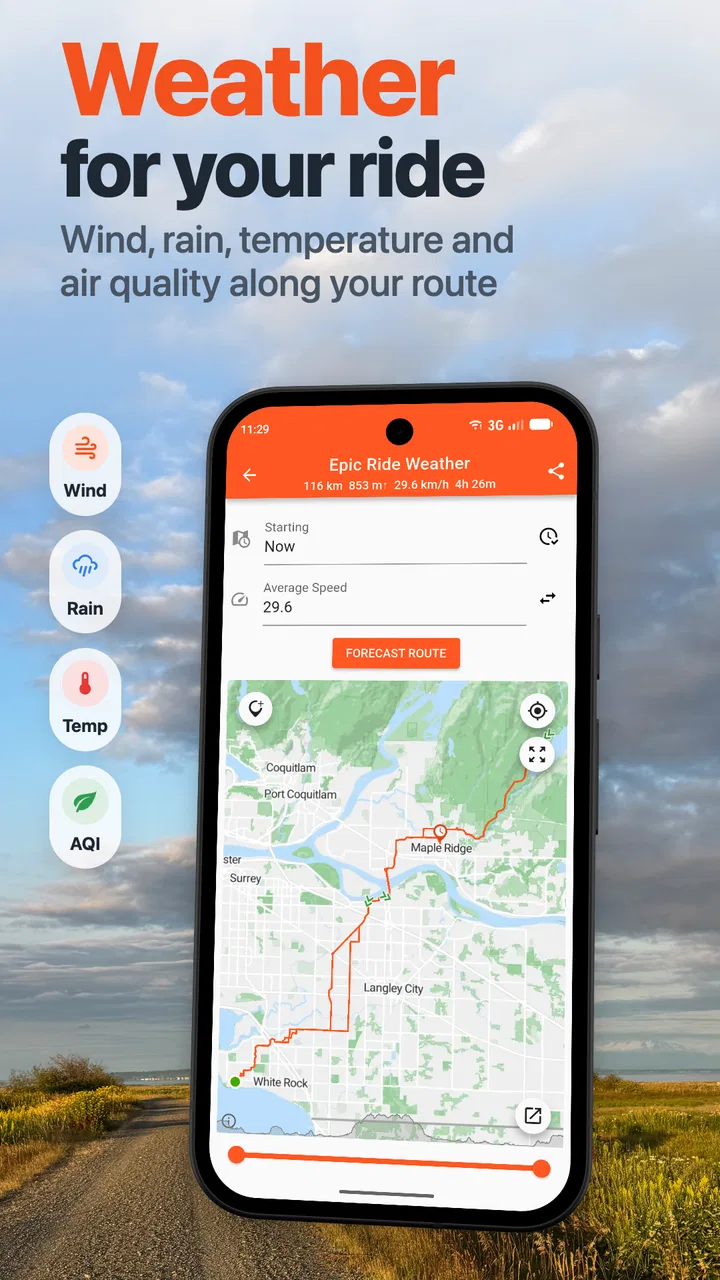
Epic Ride Weather
- 4.6
- Rating
- 100.00K
- Installs
- Free
- Price

 Analysis by App-foxy
I approached Epic Ride Weather as someone who already checks the forecast before leaving home but wants more useful information than a single temperature and rain icon. The app comes from Green's Opinion and sits in the weather category, yet its focus is much narrower and more practical than a general-purpose forecast: it is designed around the conditions you may meet during an entire ride. That difference matters. A normal weather app helps me decide whether to take a jacket. This one is intended to help me think about the route, timing, and changing conditions from departure to arrival.
That focus gives it an immediate appeal for cyclists, touring riders, commuters, and anyone planning a long outing where the weather at the starting point is not the weather that matters most. I found the idea easy to understand within minutes, but the more important question is whether it remains useful after the novelty of seeing a ride-oriented forecast wears off. In my experience, its lasting value depends less on casual weather checking and more on whether riding is a regular part of your routine.
What makes the first week appealing
The strongest first impression is that Epic Ride Weather encourages a different question. Instead of asking, “What is the weather like here?” I am pushed toward asking, “What will I experience while I am moving through this route?” That is a much better question for a long bike ride. A calm morning at home can turn into wind, heat, or rain several miles later, and a general forecast often makes me do that mental translation myself.
You May Also Like

 Blood Strike: 2.5 Anniversary
Blood Strike’s Loadouts Turn Every Drop Into a Tactical Gamble
A close look at Blood Strike’s custom loadouts: how fast access to signature weapons reshapes its battle royale rhythm, rewards preparation, and narrows the gap between fights.

 Pandora - Music & Podcasts
Pandora’s Music Is Easy to Start, but Harder to Recover
Pandora’s strength is its low-effort path from a seed to a station. Its weak spot is how much confidence it asks you to place in connection, setup, and quiet recovery.

 8 Ball Pool
 Is Built on Rivalries, Rematches, and Routine
A close look at the rivalries, rematches, shared routines, and unanswered safety questions that turn a quick pool match into a persistent mobile community.

 Samsung Music
’s Quiet Strength Is Playing What You Already Own
Its reach comes less from spectacle than from dependable access to a personal library. That simplicity is both the app’s strongest retention engine and its ceiling.

 AccuWeather: Weather Radar
AccuWeather Review: A Quick, Clear Forecast for Everyday Decisions
For everyday plans, the best forecast is the one you can understand quickly. AccuWeather makes rain timing, radar, and local conditions easy to act on, with a few trade-offs.

 Hill Climb Racing
Why Hill Climb Racing Still Turns Crashes Into One More Run
A tiny car, a bumpy hill and one more upgrade: Hill Climb Racing keeps resurfacing because its simple chaos makes every near-miss feel personal.
More From Our News Desk



The store summary describes weather and air quality forecasts for an entire ride, and that is the central reason to try it. Air quality is especially useful when a route involves sustained effort. Someone taking a short walk may not care about small changes along the way, while a rider spending hours outdoors may reasonably want to consider both atmospheric conditions and ordinary weather before committing to a route.
I also like the app’s audience clarity. It does not feel as though it is trying to be everything for everyone. The short description, “Epic Ride Weather,” makes its purpose obvious, and that specialization is more helpful than a crowded dashboard filled with unrelated weather tools. When an app is built around one activity, the information has a better chance of matching the decisions that activity requires.
During an initial trial, I would use it before a weekend ride rather than opening it repeatedly throughout the day. First I would check the whole route, then compare the expected conditions with my planned departure time, clothing, water, and possible stopping points. That workflow is more sensible than reacting to each hourly change separately. The app becomes a planning aid, not merely another place to glance at a temperature number.
Why route-wide thinking is more useful than a local forecast
A local weather app is usually excellent at answering questions about one place. It can tell me whether it is raining outside, whether the afternoon will be warmer, or whether I should carry an umbrella. The weakness appears when a trip crosses several neighborhoods, towns, or exposed areas. A route-based forecast is valuable because it matches the way the journey actually unfolds.
There is also a practical psychological benefit. Seeing conditions connected to a ride can make me reconsider the route itself, not just my clothing. If the forecast suggests an uncomfortable stretch, I may choose a shorter loop, leave earlier, or plan a more sheltered alternative. That is a more mature use of weather information than waiting until the sky changes and then hoping the forecast was close enough.
One non-obvious advantage is that the app can help separate “bad weather” from “bad ride timing.” A route may be perfectly manageable at one time and unpleasant later because of heat, wind, or air quality. That distinction gives the forecast more decision-making value. I am not simply deciding whether to ride; I am deciding when the ride makes the most sense.
Who will notice the difference quickly
Regular cyclists are the obvious audience, especially people who plan longer rides instead of making spontaneous short trips. It can also suit riders who are sensitive to air quality, commuters whose route changes across a city, and touring cyclists who need to think beyond the conditions outside their front door. Even a recreational rider can benefit when a planned outing lasts long enough for the forecast to change along the route.
On the other hand, I would not recommend installing it automatically for someone who only wants a simple daily forecast. If your usual question is whether to walk to a nearby shop or whether to bring a coat to work, a standard weather app may be quicker and less specialized. Epic Ride Weather earns its place when the ride itself is the unit of planning.
What remains useful after the novelty fades
The first week is about discovering the concept. The following month is about habit. For me, the app would need to become part of a repeatable preparation routine rather than an interesting tool I open only when I remember it exists. Its month-to-month value comes from reducing guesswork before recurring rides: a commute, a weekly training route, a regular club outing, or a familiar weekend loop.
The best long-term workflow is deliberately simple. I would check the route before making final plans, note the most uncomfortable section rather than trying to memorize every detail, and then make one practical adjustment. That adjustment might be an earlier start, a different layer, extra water, or a decision to postpone. The app is most useful when it leads to an action. If I only browse the forecast without changing anything, it becomes another source of information competing for attention.
That makes the app’s recurring value somewhat dependent on the rider. Someone with a stable riding habit can build it into preparation naturally. Someone who rides only a few times each season may find the specialized view less compelling between outings. I see this as an important trade-off: the app’s focus is its strength, but the same focus limits how often a non-rider will have a reason to open it.
Air quality gives the app a second layer of usefulness beyond rain and temperature. It can influence whether I choose a hard effort, an easy ride, or an indoor alternative. I would not treat one forecast as an absolute health decision, but I appreciate having that consideration alongside the ride conditions rather than needing to consult a separate source. This is one of the details that can keep the app relevant after the initial route-planning novelty disappears.
A realistic everyday scenario
Imagine I have a commute that starts early, crosses a busy area, and ends in a different part of town. A normal forecast may show pleasant conditions at home and encourage me to leave in light clothing. Epic Ride Weather gives me a reason to think about the complete trip instead. I can consider whether the return journey will be warmer, whether the route may become uncomfortable later, and whether air quality changes the appeal of riding hard that day.
In that situation, I would not use the app to make every tiny decision. I would use it once before leaving and again when planning the return if the schedule changed. The useful outcome might be as modest as packing a layer or choosing a less ambitious pace. That is exactly the kind of recurring benefit I want from a utility app: small decisions that prevent a larger inconvenience.
For a longer weekend ride, the same process becomes more valuable. I would look at the entire outing before committing to the distance, identify the portion most likely to shape the experience, and keep a backup plan in mind. A forecast cannot remove uncertainty, but it can make the uncertainty visible early enough to respond sensibly.
Where it compares well with ordinary weather apps
General weather apps usually win on breadth. They may cover many locations, offer broad daily information, and serve a household’s different needs in one place. Epic Ride Weather has a narrower job, so I would not replace a general weather app solely because I ride a bicycle. Instead, I would use the specialized app when the route and duration matter more than a quick local glance.
The comparison is therefore not really about which app has more features. It is about which app frames the problem better. A general forecast starts with a location. Epic Ride Weather starts with the ride. For a short trip, the location-based approach is probably enough. For a route that moves through changing conditions, the ride-based approach feels more natural and can save me from stitching together several local forecasts mentally.
That specialization also creates a limitation. If I want a broad household weather tool, a wide range of unrelated forecast views, or a single app for every outdoor activity, I may prefer a conventional alternative. Epic Ride Weather makes the most sense as a focused companion, not necessarily as the only weather app on a phone.
Maintenance, friction, and the reasons habits can break
The maintenance burden appears manageable, but it is not zero. Any route-focused weather tool asks me to remember to use it before the ride, and that extra step can disappear when I am rushed. The app cannot help if I open it only after I am already halfway through the journey. Its value is preventative, which means the habit has to happen before the problem.
There is also a potential decision-fatigue issue. Weather forecasts are inherently changeable, and a rider who checks too often may become less confident rather than better prepared. I would avoid treating every small shift as a reason to cancel or redesign a ride. A better approach is to establish a personal threshold: decide which conditions genuinely change the plan, then ignore minor fluctuations that do not affect safety or comfort.
Another source of friction is the difference between forecast detail and real-world experience. A route can contain shade, exposed roads, traffic, hills, and stops that alter how the conditions feel. A ride-oriented forecast helps me prepare, but it cannot understand every personal factor that affects comfort. I still need judgment about fitness, clothing, hydration, and whether I am comfortable riding in the expected conditions.
I would also be cautious about relying on the app as the sole authority for a serious outing. Forecasts can be wrong, conditions can shift, and air quality can change for reasons that are not obvious from a single check. The app is most effective when it supports sensible planning rather than replacing it.
Costs and platform expectations
The app is free to download, which makes trying the route-based approach relatively easy. It is rated for Everyone, so its presentation is aimed at a broad audience rather than a restricted age group. The developer is Green's Opinion, and the app has built a respectable user base, with over one hundred thousand installs and an average rating of 4.6 from roughly eight hundred ratings. Those figures suggest that the concept has found an audience, although they should not replace personal testing.
There are in-app purchases ranging from $2.99 to $19.99 per item. That matters for long-term value because a free entry point does not automatically mean every useful part of the experience is free. Before building a daily routine around the app, I would check which tools are available without payment and whether the paid options match the way I ride. A casual cyclist may be satisfied with the basic experience, while a frequent rider may decide that the additional cost is justified if it supports regular planning.
The current version is 2.4.1, and the minimum operating system is Android 7.0. That makes the app accessible to people using older Android phones, which is useful if a spare device is mounted on a bike or kept for navigation. Still, I would keep the app updated when practical, particularly for a weather utility where reliability matters more than novelty.
Three practical habits that improve the experience
Check before the route becomes fixed. I would look at the forecast before choosing the distance or departure time, not after all plans are already committed. This turns the information into a planning tool rather than a confirmation screen.
Plan around the hardest section. Instead of averaging the whole ride mentally, I would identify the part most likely to feel unpleasant and prepare for that section. A route can be mostly comfortable while one exposed or late-day stretch determines the entire experience.
Use air quality as a pacing signal. I would not view it only as a yes-or-no reason to ride. It can help me decide whether the day suits a relaxed outing, a demanding effort, or a shorter alternative.
These habits also reduce fatigue. They keep the app from becoming a stream of numbers that I repeatedly recheck without making a decision. The goal is not to predict every minute perfectly; it is to make one or two better choices before leaving.
Who should keep it installed?
I think Epic Ride Weather earns lasting space on a phone for people who ride often enough to have a preparation routine. It is particularly convincing when a route covers enough distance for conditions to vary, when air quality affects the decision to exercise outdoors, or when a commuter regularly starts and finishes in different weather situations.
I am less convinced for occasional riders whose trips are short and local. In that case, the extra route-oriented step may not repay its cost in attention. A standard weather app is likely to be faster for a quick decision, and there is nothing wrong with choosing the simpler tool when the problem is simple.
I would also skip making it the center of my planning if I wanted a complete navigation or outdoor-adventure system. Its value is forecasting around the ride, not replacing every other tool involved in route choice, safety, navigation, or equipment. The best setup may be a combination: a familiar navigation method for the route and Epic Ride Weather for conditions along it.
What I appreciate most is that the app encourages better questions without pretending to eliminate uncertainty. It reminds me that a ride is a timeline and a path, not a single point on a map. That perspective is more useful than another colorful forecast screen, provided I actually use it before making plans.
My long-term verdict
After the first-week appeal fades, Epic Ride Weather still has a credible reason to remain installed, but only for the right kind of user. Its recurring value comes from repeated rides, route changes, and decisions where weather and air quality can affect comfort or effort. It is not a universal replacement for every weather app, and it does not need to be. Its focused purpose is precisely why it can be more helpful than a broader alternative in the situations it targets.
My recommendation is strongest for regular cyclists and commuters who are tired of checking the forecast at home and discovering that the rest of the ride feels different. I would encourage those users to try the free version, establish a once-before-the-ride habit, and judge the paid options only after seeing whether the app genuinely changes their planning. The free entry point lowers the risk, while the in-app purchase range makes it sensible to consider ongoing value rather than buying impulsively.
For someone who rides rarely, takes short trips, or prefers one general-purpose weather app for the whole household, I would choose the simpler alternative. For someone who treats riding as a regular part of life, I see a more durable benefit. Its best feature is not merely showing a forecast; it is helping me plan the experience of the entire ride. That is enough to give it a permanent place in my cycling routine, as long as I use it with judgment and do not confuse a useful forecast with a guarantee.
FAQs for Epic Ride Weather
01What is Epic Ride Weather used for?
Epic Ride Weather is designed for cyclists, motorcyclists, and outdoor adventurers who need weather information along a planned route rather than only at a single location. It can show changing conditions as you progress through a ride, helping you anticipate rain, wind, temperature changes, and other weather factors before and during your trip. It is especially useful for route planning and deciding when to leave or adjust your itinerary.
02How does Epic Ride Weather calculate the forecast for a route?
The app uses your selected route, expected travel speed, departure time, and weather forecast data to estimate the conditions you may encounter at different points along the journey. Instead of presenting one general forecast, it attempts to match weather conditions with your likely arrival time at each location. Forecast accuracy still depends on the quality of the weather data, route details, and how closely your actual speed and schedule match the plan.
03Can Epic Ride Weather connect with cycling apps and navigation services?
Epic Ride Weather is intended to work with route-based planning and may support importing or connecting routes from popular cycling and navigation platforms, depending on the current version and device. Compatibility can change, so users should check the app’s latest listing and supported services before downloading. If a direct connection is unavailable, route files or manually selected routes may provide an alternative for planning a trip.
04Is Epic Ride Weather free to download and use?
The app may be available to download at no initial cost, but some advanced features can require a subscription or in-app purchase. Premium access may include more detailed route forecasts, extended planning tools, additional weather information, or integrations with other services. Pricing and included features can vary by platform, region, and app version, so review the store listing carefully before starting a trial or completing a purchase.
05Does Epic Ride Weather work without an internet connection?
Epic Ride Weather generally needs an internet connection to retrieve current forecasts, update route conditions, and synchronize information with connected services. You should plan your route and load the relevant data before entering an area with weak coverage, but offline availability may be limited and can depend on the feature being used. The app should be treated as a planning aid, not as a replacement for local weather awareness or emergency preparation.
Pros
- Shows weather conditions along the entire planned route.
- Useful for choosing a safer and more comfortable departure time.
- Supports cycling-focused weather details such as wind and rain.
- Route-based forecasts are more practical than standard city weather apps.
- Can help compare alternative routes and identify exposed sections.
Cons
- Its usefulness depends on having an accurate route available.
- Detailed route weather may require a compatible planning service.
- Forecast accuracy can vary significantly over longer distances.
- The amount of data may feel overwhelming for casual cyclists.
- Some advanced features may depend on a paid subscription.

Epic Ride Weather
Gallery